

N.º 04Cuts
Mollejas: Argentine sweetbreads, heart or throat, and how to order
Mollejas are veal thymus sweetbreads, an asado favorite. Heart vs. throat sweetbreads, whether to blanch first, and why abroad sweetbreads can mean pancreas.
Updated 9 min read27 sources

Contents
Mollejas are the thymus: a gland in young animals with one part in the chest, next to the heart, and another in the neck, along the sides of the windpipe. The Argentine Food Code (Código Alimentario Argentino) defines them that way, "thymus (molleja)", and lists the pancreas as a separate offal item [1]. They are trimmed of fat and membranes and go on the parrilla (the grill) over medium heat until golden and crisp; whether to blanch them first is one of the great debates of the asado (the Argentine barbecue: the meal, the event and the technique). Abroad, the problem is the word: sweetbreads, ris, animelle or Bries can include the pancreas, which under the Code is not molleja.
Mollejas
- Primal
- Offal — thymus
- Location
- The thymus, a gland of young animals with one portion in the chest, next to the heart, and another in the neck, on either side of the trachea.
- Also known as
- molleja de corazón · molleja de garganta · molleja de cogote
- Bone
- Boneless
- Cooking
- grill · griddle
- IPCVA code
- 607
- HAM / AUS-MEAT
- 6110 · Thymus gland
Equivalents by country · Mollejas
- United States
Sweetbreads (thymus)
Code: IMPS 1722
'Sweetbread' can be thymus or pancreas: ask for 'thymus'. IMPS 1722 describes only the neck thymus (molleja de garganta), not the chest one (molleja de corazón).
- United Kingdom
Sweetbreads (thymus)
Same product, but 'sweetbreads' also refers to the pancreas: ask for thymus. AHDB has no offal specification of its own.
- FranceExact match
Ris de veau (la gorge y la noix)
Veal thymus: the gorge (elongated) is the molleja de garganta and the noix (round) the molleja de corazón. Ris de bœuf is rarely sold because the thymus regresses in adult animals.
- BrazilExact match
Timo / moleja (churrascarias)
Code: ABIEC 640
ABIEC 640 = thymus = molleja. The pancreas would be 'pâncreas', and the throat and heart variants are ordered as timo cervical or torácico.
- GermanyExact match
Kalbsbries / Bries (Halsbries, Schlundbries)
Bries is the thymus; the pancreas is Magen- or Bauchbries. 'Herzbries' for the chest thymus is not verified.
- Italy
Animelle (di vitello)
'Animelle' covers thymus and pancreas without distinction. One source says 'animella del cuore' = pancreas, the reverse of Argentine usage: have the butcher show you the piece.
- ChinaExact match
胸腺xiōngxiàn
IPCVA 607, AUS-MEAT 6110 and ABIEC 640 agree. The pancreas would be 胰腺 (yíxiàn), with no verified trade name.
How to ask for it
- English
Whole veal thymus sweetbreads, please, not pancreas.
- French
Des ris de veau entiers, non blanchis, pour la plancha.
- German
Kalbsbries vom Thymus, am Stück, bitte.
- Italian
Animelle di vitello, il timo, non il pancreas.
- Portuguese
Timo de vitelo (moleja), inteiro e limpo.
- Chinese
请给我整块的牛胸腺。
What they are
The cut chart of the IPCVA (Argentine Beef Promotion Institute; offal item 607) says the molleja "is made up of the thymus, a gland formed by a cervical portion and a thoracic portion", which "reaches its greatest development in calves, atrophying in adult animals" [2]. That is why good mollejas come from young animals. Uruguay's INAC (National Meat Institute) agrees: "thymus gland of young animals" [3].


The first photo shows what it looks like raw: white and lobed. In the diagram, the yellow patch marks the two parts of the thymus, the chest part and the neck part, which account for the two kinds of molleja.
Heart sweetbreads and throat sweetbreads
Argentine butchers tell two apart, and for one of them there are three versions:
| Source | Molleja de corazón (heart) | Molleja de garganta, or de cogote (throat) |
|---|---|---|
| Diario Democracia (2013), citing the cut chart | Thoracic thymus, with a "fattier" texture | Cervical thymus, more "glandular" [4] |
| Darío Gualtieri, butcher (La Nación, 2022) | "The thymus" | "The carotid gland" [5] |
| INAC (Uruguay, 2023) | The thymus | "False sweetbread": the salivary gland of the parotid and mandibular region [3] |
On the heart sweetbread there is consensus: it is the chest thymus. The throat sweetbread is the disputed one. For the Argentine cut chart it is the other half of the thymus; Gualtieri's "carotid gland" is a loose name, since there is no edible gland called that; and INAC flatly considers it a false sweetbread. We use the IPCVA definition: both are thymus, and what the counter sells as throat may not be.
On texture, cooks agree more: the throat sweetbread "is firmer, with a bite closer to meat", and the heart sweetbread "is all softness, almost butter, because of its fat" [18]. Francisco Pidal, of Canta el Gallo, also describes the heart sweetbread as the fattier one [20]. One Diario UNO article says the opposite [21], so it is better to look at the piece than to trust the name.
The pancreas is not molleja
In other countries the pancreas is sold as sweetbread. In Argentina the Food Code lists it separately, in the same list of offal in which it defines molleja as thymus (art. 252) [1].
The video below shows the difference between heart and throat sweetbreads, and four ways to cook them.
How to choose them
- Heart sweetbreads, for the grill. Liber Acuña, of El Pobre Luis: "for the grill, the best is the heart one" [17]. La Cabrera prefers them too: they are fattier, but "bigger and tastier" [19]. Germán Sitz, of La Carnicería, prefers the more compact throat sweetbread instead, which he blanches and fries [17].
- Fresh. A Spanish offal guide asks that they look clean and pink, with no spots or dryness, that they not be gelatinous or fall apart in your hand, and that they not smell of ammonia [22].
- How much. Diario UNO allows 200–250 g (7–9 oz) per person when sweetbreads are the main event [21]; at an asado with other achuras (offal grilled at an asado) you buy much less (see how much meat per person).
How to clean them and whether to boil them
Before cooking you need to remove all the fat and connective tissue that wraps them, as the IPCVA and INAC require [2] [3]. The classic kitchen technique has four steps: soak in cold water for about two hours, changing the water; blanch briefly; plunge into cold water to stop the cooking; and only then remove veins, fat and skins. Afterward they can be pressed to give them an even shape [23].
On blanching, there are two schools with names attached:
| Position | Who and how |
|---|---|
| Blanch them | La Dorita: 15 minutes of boiling and about 15 on the grill [6]. Pidal: 10 to 15 minutes in water with coarse salt and a glass of sherry, "until firm" [20]. The Puchero bodegón (old-style tavern): 10 to 12 minutes [18]. |
| Straight on the grill | Carlos López, of the Escuela Argentina de Parrilleros (Argentine grill school): "you don't boil it" [7]. Laucha Luchetti, of Locos por el Asado: "never boiled, always grilled", moistened every 10 minutes with vinegar or lemon [24]. |
Either way they go over medium heat and come off when golden and crisp outside. Liber Acuña cooks them over wood and charcoal, with nothing on them, "in just eight minutes per side", and finishes them with salt and lemon [17]; La Cabrera renders the fat slowly over low heat and gives them a blast of high heat at the end [19]. They go on after the large cuts and the chinchulines, together with the thin cuts [8]. See The order of an asado and Asado cooking times.
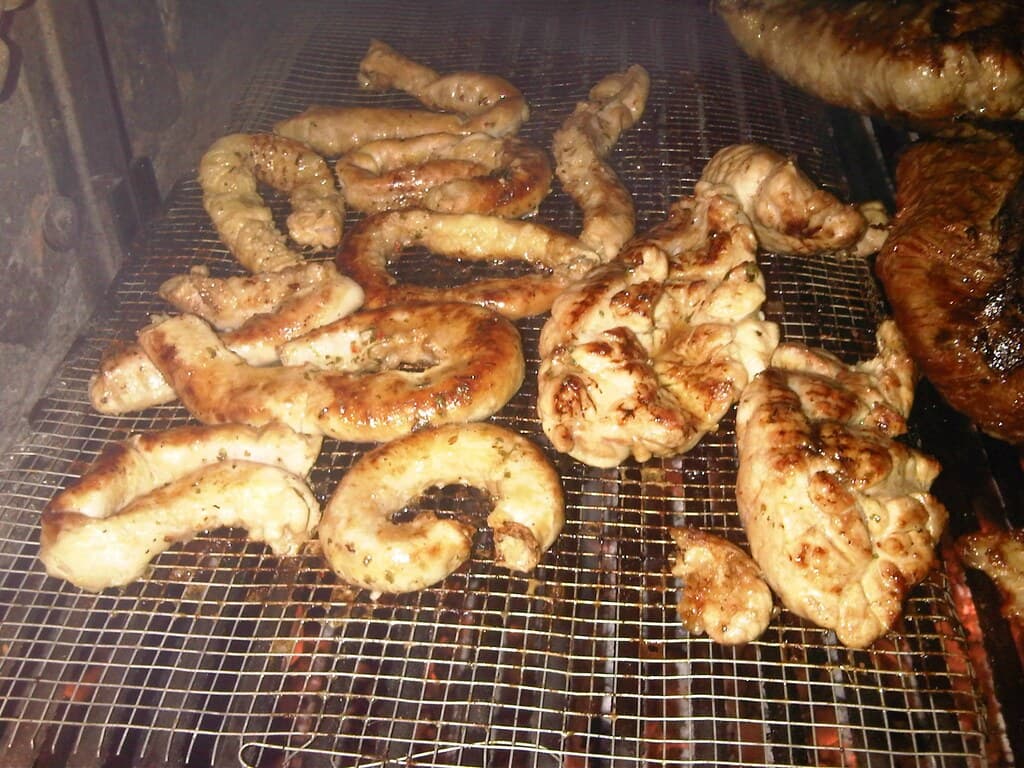
In the photo, the mollejas share the grill with chinchulines (beef small intestine), as at almost every asado. In the class below, Gastón Riveira, of La Cabrera, shows the cleaning, the fire and the doneness.
Two classic recipes
Grilled mollejas with lemon
This is Diario UNO's version, with no boiling first [21]:
- Grill them whole over medium heat (by the hand test, you can hold your hand over the grill for 7 or 8 seconds), 30 to 40 minutes per side.
- Cut them butterflied or into slices about 2 cm (¾ in) thick.
- Stoke the fire, salt them and squeeze lemon over them. Another 10 to 15 minutes, flip and repeat the lemon.
- They are ready when you hear a faint crackle.
The lemon goes on at the end because, if added earlier, the sweetbread boils in the juice instead of grilling [21].
Mollejas al verdeo (with green onions)
This is a skillet dish. Chef Diego Gera's version [25]:
- Soak and blanch. Six hours in water; then 15 minutes from the boil in 1 liter (about 1 quart) of milk with bay leaf, thyme and clove. Cool, press and refrigerate overnight.
- Brown. Separate into lobes and brown them in a skillet until caramelized.
- The green onions. Add salt, red onion sliced lengthwise and 300 g (10½ oz) of green onions cut on the bias.
- Wine and cream. Add white wine and let it evaporate; stir in cream, bring to a boil and reduce.
Guillermo Calabrese's version on MasterChef blanches them in water with coarse salt and bay leaf, 15 minutes from the boil, and adds a splash of port and red pepper flakes to the white wine [26].
Storage. Like other offal, raw sweetbreads keep for one or two days in the refrigerator [27].
What they're called in other countries
Mollejas have no UNECE code. The trade reference is the thymus gland item 6110 of the Australian handbook, which INAC also uses [3]. The rule everywhere: ask for thymus, not the generic word. The FAO records that sweetbread is the culinary name for either the thymus or the pancreas [9].

- United States. Sweetbreads (thymus), IMPS 1722, an approximate match: the item describes only the neck thymus, the throat sweetbread, not the heart one [10].
- United Kingdom. Sweetbreads, an approximate match: ask for thymus, because the word also covers the pancreas [9].
- France. Ris de veau, an exact match. According to the Larousse gastronomique, as quoted by Tastet, the ris has an elongated part, the gorge, which is the throat sweetbread, and a round one, the noix, which is the heart sweetbread; some English-language sources say the noix is the pancreas. Ris de bœuf is hardly ever sold, because the thymus atrophies in adult cattle [11].
- Brazil. Timo (ABIEC 640), an exact match; in churrascarias also moleja [12]. It appears as "timo" in Rio Grande do Sul's tax list of cuts [13].
- Germany. Kalbsbries or Bries, an exact match. The thymus is Hals- or Schlundbries; the pancreas, Magen- or Bauchbries [9]. We found no source for "Herzbries" as the name of the heart sweetbread.
- Italy. Animelle, an approximate match: the word covers thymus and pancreas without distinction. One source calls the pancreas animella del cuore, the reverse of Argentine usage [14]. The safe move is to ask the butcher to show you the piece.
- China. 胸腺 (xiōngxiàn), an exact match: the IPCVA's Chinese cut chart [15], the Australian handbook [16] and ABIEC agree. The pancreas would be 胰腺 (yíxiàn).
How to order them abroad
| Where | What to say |
|---|---|
| US and UK | "Whole veal thymus sweetbreads, please, not pancreas." |
| France | « Des ris de veau entiers, non blanchis, pour la plancha. » |
| Brazil | "Timo de vitelo (moleja), inteiro e limpo." |
| Germany | „Kalbsbries vom Thymus, am Stück, bitte." |
| Italy | «Animelle di vitello, il timo, non il pancreas.» |
| China | 请给我整块的牛胸腺。 |
More tips in Argentine beef cuts in English.
Frequently asked questions
- What part of the cow are mollejas?
- The thymus, a gland in young animals with one part in the chest and another in the neck. The Argentine Food Code defines it that way and lists the pancreas as a separate offal item.
- What is the difference between heart and throat sweetbreads?
- The heart sweetbread (molleja de corazón) is the chest thymus: larger, softer and fattier, the favorite for the grill. The throat sweetbread (molleja de garganta) is firmer; depending on the source, it is the other half of the thymus or a salivary gland.
- Do you have to boil sweetbreads before grilling them?
- It is not required, and asadores don't agree. Some blanch them for 10 to 15 minutes; Carlos López and Laucha Luchetti put them straight on the grill.
- How long do sweetbreads take on the grill?
- It depends on size and on whether they were blanched: from about 15 minutes if already boiled to 30 or 40 minutes per side if raw and whole, always over medium heat.
- How do you clean sweetbreads?
- Remove all the fat and the membranes that wrap them. In the classic technique they are soaked in cold water, blanched for a few minutes, cooled, and only then peeled.
- What are mollejas called in English?
- Sweetbreads, but the word also covers the pancreas. Ask for 'thymus sweetbreads'; in the United States, IMPS item 1722.
Sources
- [1]ANMAT — ANMAT — Código Alimentario Argentino, Capítulo VI: Alimentos cárneos y afines (act. 04/2025)argentina.gob.ar · accessed 8 November 2026
- [2]IPCVA (Argentine Beef) — IPCVA — Nomenclador de cortes vacunos (argentinebeef.org.ar)argentinebeef.org.ar · accessed 8 November 2026
- [3]Instituto Nacional de Carnes — INAC (Uruguay) — Manual uruguayo de cortes bovinos (2023)uruguaymeats.uy · accessed 8 November 2026
- [4]Diario Democracia — Fontoira, L. (2013). La molleja: el caviar del asado argentinodiariodemocracia.com · accessed 8 November 2026
- [5]La Nación — Cuculiansky, S. (2022). Darío Gualtieri explica cómo debe verse, cómo debe oler y qué molleja hay que pedirlanacion.com.ar · accessed 8 November 2026
- [6]La Nación — Chorizo, morcilla y mollejas: ¿cómo hacer bien las achuras?lanacion.com.ar · accessed 8 November 2026
- [7]Infobae — Chorizo, mollejas y morcilla: cómo cocinar las achuras a la perfección (Carlos López, Escuela Argentina de Parrilleros)infobae.com · accessed 8 November 2026
- [8]Crónica — El secreto del asado definitivo: en qué orden colocar carnes, chorizos, morcillas y achuras en la parrillacronica.com.ar · accessed 8 November 2026
- [9]FAO — AGROVOC c_7551 sweetbreadsagrovoc.fao.org · accessed 8 November 2026
- [10]USDA Agricultural Marketing Service — IMPS for Variety Meats and Edible By-Products, Series 700, DRAFT 9-30-2020ams.usda.gov · accessed 8 November 2026
- [11]Tastet — Ris de veau (cita al Larousse gastronomique)tastet.ca · accessed 8 November 2026
- [12]ABIEC — Livro Brasileiro de Cortes Bovinos / Brazilian Beef Cuts Book (glosario en 12 idiomas)abiec.com.br · accessed 8 November 2026
- [13]Governo do Rio Grande do Sul — Instrução Normativa DRP nº 63/2002 (lista fiscal de cortes)normasbrasil.com.br · accessed 8 November 2026
- [14]Italian Food Decoder — Animellefacarospauls.com · accessed 8 November 2026
- [15]IPCVA (Argentine Beef) — 切割部位命名表 (nomenclador de cortes en chino)argentinebeef.org.ar · accessed 8 November 2026
- [16]AUS-MEAT — 澳洲肉品手册 第七版 (Handbook of Australian Meat, 7.ª ed., versión china; espejo no oficial)sstory.top · accessed 8 November 2026
- [17]La Nación — Mollejas. Tres versiones bien distintas de este lujo del campo argentino (2019, act. 2023)lanacion.com.ar · accessed 8 November 2026
- [18]La Nación (Revista Lugares) — Jemio, D. (2026). El lujo del asado que algunos restaurantes se animan a reinventarlanacion.com.ar · accessed 8 November 2026
- [19]La Nación — Receta de tabla de achuras para llevar el asado a un nivel superior (2021)lanacion.com.ar · accessed 8 November 2026
- [20]MinutoUno — Claves para hacer mollejas, chinchulines y riñones a la parrilla (Francisco Pidal, 2022)minutouno.com · accessed 8 November 2026
- [21]Diario UNO — Guayama, M. (2026). Cómo hacer mollejas al limón en el asadodiariouno.com.ar · accessed 8 November 2026
- [22]Directo al Paladar — De las Heras, J. (2023). Qué son las mollejas, qué tipos hay y cómo usar en cocina esta pieza de casqueríadirectoalpaladar.com · accessed 8 November 2026
- [23]EROSKI Consumer — Limpieza de las mollejas (2008)consumer.es · accessed 8 November 2026
- [24]El Cronista — Oyakawa, A. (2026). Laucha Luchetti, de Locos por el Asado, reveló el truco para hacer mollejas a la parrillacronista.com · accessed 8 November 2026
- [25]elgourmet — Mollejas al verdeo (Diego Gera, Hecho en Casa)elgourmet.com · accessed 8 November 2026
- [26]Diario El Sol (Mendoza) — MasterChef: cómo hacer mollejas al verdeo (2021)elsol.com.ar · accessed 8 November 2026
- [27]University of Arkansas Cooperative Extension — Storage Times for Refrigerated Foods (según USDA FSIS)uaex.uada.edu · accessed 8 November 2026
Keep reading
- CutsChinchulines: what they are, how to grill them and how to order them
- CutsRiñón: grilled beef kidney in Argentina, how to clean and order it
- CutsArgentine chorizo: the fresh grilling sausage and how to order it
- CutsMorcilla: the Argentine blood sausage you only reheat on the grill
- AsadoThe order of an Argentine asado: what goes on the grill first and why
- AsadoAsado cooking times by cut and grill height