

N.º 01History
Hides, tasajo and saladeros: beef before refrigeration (1778–1914)
From free trade in 1778 to Liebig at Fray Bentos: how many hides were exported, where salted tasajo beef went and why the saladeros closed once slavery ended.
Updated 5 min read8 sources
Contents
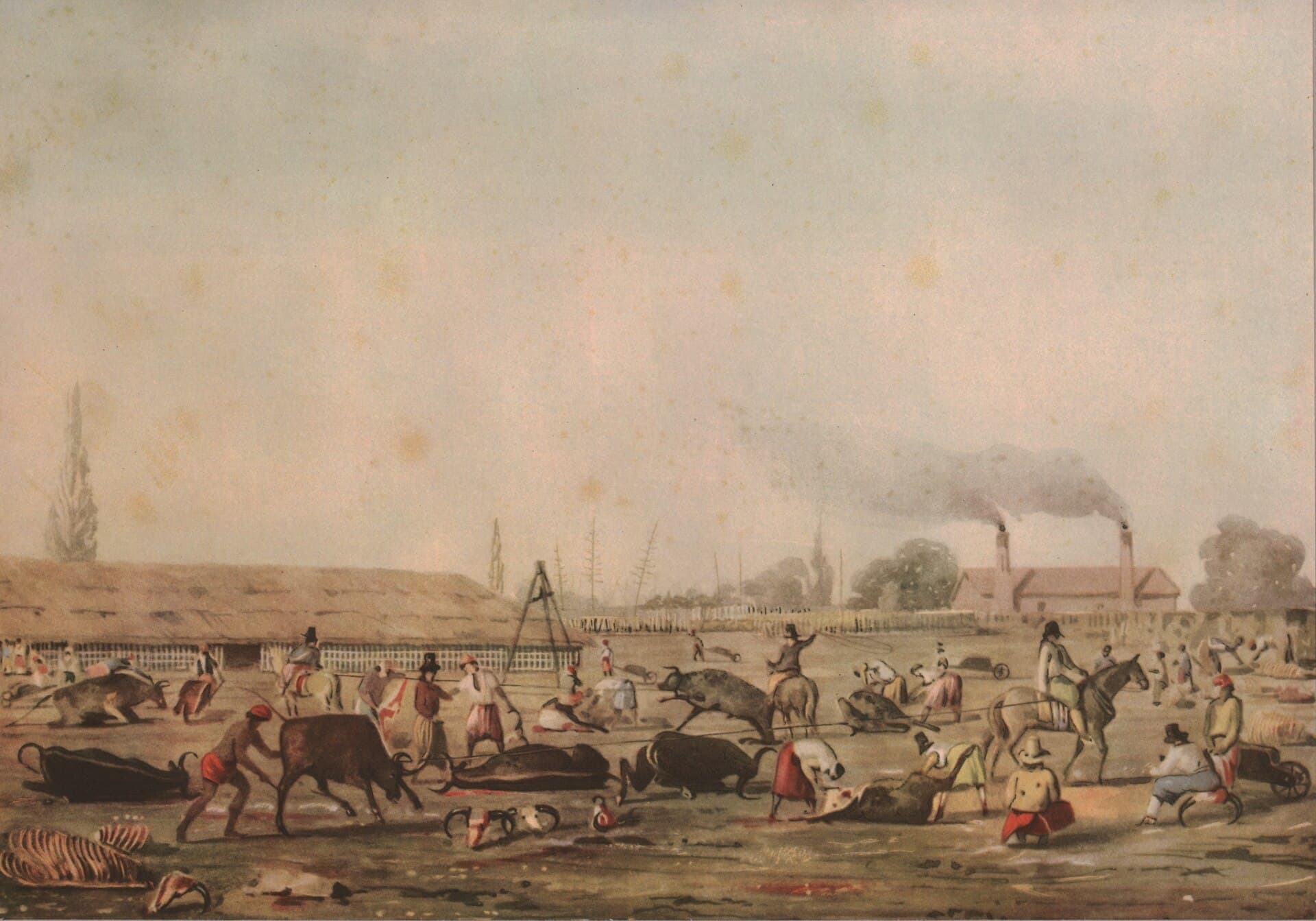
Between the opening of trade in 1778 and the arrival of refrigerated meatpacking, cattle ranching in the Río de la Plata lived off hides, tallow and salted beef. The saladero, a meat-salting plant, turned Criollo steers into tasajo, beef that was salted and dried in the sun so it could travel for weeks without refrigeration, and that fed enslaved people in Cuba and Brazil. The first one on the Buenos Aires side of the river opened at Ensenada in 1810. The business had its golden age between 1830 and 1870 and died out with the abolition of slavery and the arrival of refrigeration: by 1914 there was not one left in the country.
1778: the port opens and hides multiply
The Regulation of Free Trade of 1778 allowed Buenos Aires to trade directly with the ports of Spain [1]. According to Zacarías Moutoukias's data as compiled by Lionel Barbagallo, the volume of hides exported quadrupled between the 1770s and the 1790s:
| Period | Hides exported through Buenos Aires |
|---|---|
| 1770s | ~100,000 a year |
| 1790–1796 | ~378,000 a year |
Source: Barbagallo (2015), based on Moutoukias (1996) [1].
It is often repeated that a million hides a year were exported in the late 18th century. Emilio Coni considered this an "unproven figure that seems to me exaggerated" [5].
Salted beef is born in the Banda Oriental
Regular exports of salted beef began in the late 1780s, from establishments near Montevideo in the Banda Oriental (present-day Uruguay). Nicolás Biangardi reconstructed the volumes: about 40,000 quintals a year in the early 1790s (a Spanish quintal was about 46 kg), almost 80,000 in 1796 and more than 120,000 in 1802–1803 [2]. Who founded the first saladero on the eastern bank is still debated: Francisco Medina, on the Colla stream, is usually named, with dates ranging from 1781 to 1788.

The destination was clear from the start. Between 1792 and 1796, 157,125 quintals left for Havana on 41 ships, and between 1802 and 1806, 382,471 quintals on 97 ships. In that last period another 149,246 quintals went to other colonies and countries, 71% of them to Brazil [2].
Ensenada 1810 and Las Higueritas 1815
In October 1810, months after the May Revolution, Robert Staples and John McNeile opened at Ensenada de Barragán "the first saladero on the western shore of the Río de la Plata." By 1812 it employed 60 workers [3]. Carrazzoni agrees that the first one near Buenos Aires was the one at Ensenada [4].
In 1815, in Quilmes, Juan Manuel de Rosas, Juan Nepomuceno Terrero and Luis Dorrego, brother of Manuel Dorrego, formed a partnership to run the Las Higueritas saladero [3]. Adolfo Saldías called it "the first saladero there was in the Province" [8], but Ensenada came first: Las Higueritas was one of the first backed by local (criollo) capital. It was also the foundation of Rosas's fortune before his political career.
The business drew complaints from day one. Supreme Director Pueyrredón ordered the saladeros suspended from May 31, 1817, because of their "pestilent odors" and because they drove up the price of meat for the Buenos Aires market [3] [8]. The suspension was temporary.
The golden age and the slaveholding market
The 1820s brought a great expansion, and between 1830 and 1870 the saladeros had their "golden age" [3]. Tasajo had a narrow market: the "slaveholding markets of Cuba, Brazil and the United States." It was the cheap, long-lasting ration of the enslaved workforce on sugar and coffee plantations. The industry was dirty and labor-intensive, and above all it depended on slavery continuing to exist.

By mid-century the center of gravity was already shifting toward wool. Between 1852 and 1862 wool exports rose 266%, while cattle hide exports fell 21% and salted beef exports 30% [4].
The decline: abolition, epidemics and meatpacking plants
The blows came together. Abolition in the United States (1861–1865), Cuba (1880–1886) and Brazil (1888) took away the buyers [3]. In the city of Buenos Aires, the saladeros along the Riachuelo closed for good in 1871, the year of the yellow fever epidemic. The industry moved inland: the 1895 census counted 37 saladeros in Entre Ríos and 21 in Buenos Aires province. By 1914 there were none left [3].
0
Liebig at Fray Bentos: extract of meat
On the far bank of the Uruguay River, a product was born that linked the River Plate with German chemistry. By November 1862 the engineer Georg Giebert was already sending Europe samples of extract of meat made at Fray Bentos with the method of Justus von Liebig. On April 21, 1863, he founded Giebert et Compagnie and bought an old saladero and estancia next to the natural harbor [7]. In 1865 the Liebig's Extract of Meat Company was incorporated in London with Anglo-Belgian capital, and it exported extract to Europe from that year on [6].
The factory made extract, later corned beef, and also organic fertilizer. In 1924 it was bought by the Vestey group and renamed Frigorífico Anglo del Uruguay; it closed in 1979, and in 2015 it was declared a UNESCO World Heritage Site [6]. Liebig also had a plant on the Argentine side, at Pueblo Liebig (Colón, Entre Ríos). In 1909 Entre Ríos had three extract factories and four saladeros [3].
The saladero needed a large Criollo steer with a thick hide and lean meat. The meatpacking plant would call for the opposite, an early-maturing animal with fat cover, and getting it meant fencing the land and crossbreeding the cattle.
Videos


Frequently asked questions
- What was a saladero?
- A plant where cattle were slaughtered to salt and dry the meat (tasajo or charque) and to make use of the hide and the tallow. Saladeros operated in the Río de la Plata from the late 18th century to the early 20th.
- What was the first saladero in Buenos Aires?
- The one at Ensenada de Barragán, opened in October 1810 by Robert Staples and John McNeile. Las Higueritas, in Quilmes, owned by Rosas, Terrero and Luis Dorrego, dates from 1815 and was one of the first backed by local (criollo) capital.
- Where was tasajo exported to?
- To the slaveholding economies, above all Cuba (Havana) and Brazil. The abolition of slavery in Cuba (1886) and Brazil (1888) took away its main market.
Sources
- [1]ESEADE — Lionel A. Barbagallo, El impacto del mercantilismo español en el Río de la Plata: el caso de los cueros (1790-1825), Revista de Instituciones, Ideas y Mercados n.º 62-63, 2015eseade.edu.ar · accessed 8 November 2026
- [2]SciELO Argentina — Nicolás Biangardi, Más allá del saladero. Una mirada sobre la producción de carne salada en el Río de la Plata del siglo XVIII, Folia Histórica del Nordeste n.º 37, 2020scielo.org.ar · accessed 8 November 2026
- [3]TeseoPress — Rodolfo Leyes, Saladero (Argentina, 1810-1923), en Diccionario del agro iberoamericanoteseopress.com · accessed 8 November 2026
- [4]SEDICI-UNLP — José A. Carrazzoni, El Bovino Criollo Argentino: Ayer y Hoy, Anales de la Academia Nacional de Agronomía y Veterinaria, t. LII, 1998sedici.unlp.edu.ar · accessed 8 November 2026
- [5]Biblioteca Virtual Miguel de Cervantes — Emilio A. Coni, Historia de las vaquerías de Río de la Plata (1555-1750), Boletín de la Real Academia de la Historia, t. 96, 1930cervantesvirtual.com · accessed 8 November 2026
- [6]UNESCO / ICOMOS — ICOMOS, evaluación de la candidatura Fray Bentos Industrial Landscape (n.º 1464), 2015whc.unesco.org · accessed 8 November 2026
- [7]UNESCO — Dossier de candidatura de Uruguay, Fray Bentos Industrial Landscapewhc.unesco.org · accessed 8 November 2026
- [8]Adolfo Saldías sobre los orígenes del saladero de Rosas (transcripción)revisionistasdesanmartin.blogspot.com · accessed 8 November 2026
Keep reading