

N.º 01History
Argentina's great meatpacking plants: Swift, Armour and the Anglo
Swift and Armour in Berisso, the Anglo in Avellaneda, Bovril in Santa Elena and Liebig in Colón: the rise and fall of the meatpacking plants that became towns.
Updated 8 min read18 sources

Contents
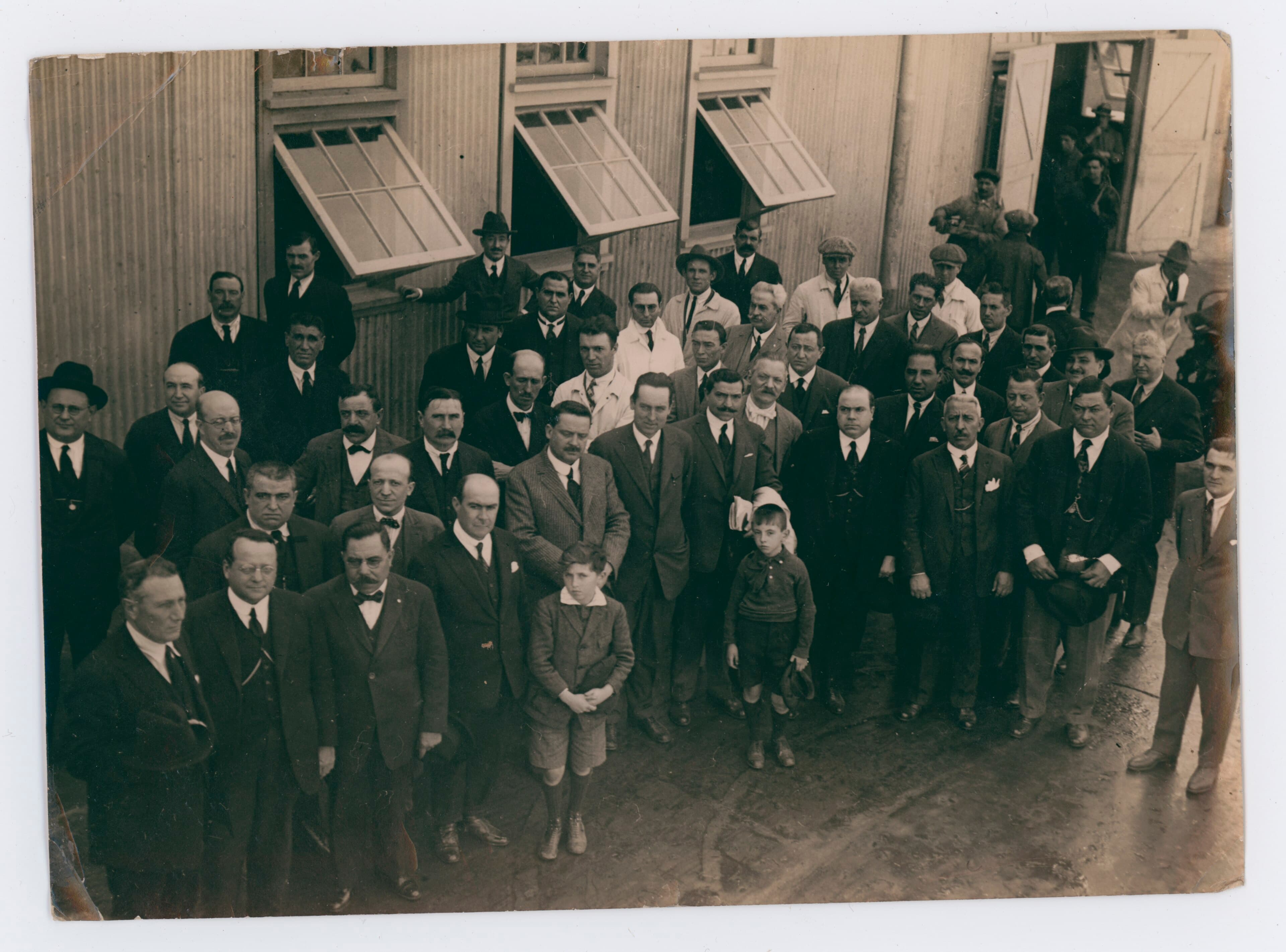
For much of the 20th century, meatpacking plants (frigoríficos) were the largest factories in Argentina, and some of them had whole towns grow up around them. In Berisso, Swift and Armour employed some 15,000 people at their peak [2]. In Avellaneda, the Anglo, La Negra, La Blanca and Wilson plants formed an industrial corridor along the Riachuelo river. In Entre Ríos province, Santa Elena and Pueblo Liebig were company towns. Their workers led some of the country's hardest-fought strikes and part of the mobilization of October 17, 1945. Almost all of those plants closed between 1969 and 1993. This chapter follows Meatpacking plants and the chilled beef trade, which tells how the business began.
Berisso: Swift and Armour
Berisso grew out of a saladero (meat-salting plant) that the Genoese Juan Berisso set up in 1871 [4]. In 1904 The La Plata Cold Storage Company, mostly South African-owned, was built on the site of the old saladeros, and in 1907 it was bought by Swift, which took three quarters of the shares [3] [1]. In 1915 Armour opened its plant next door [1]. Together the two came to employ some 15,000 workers [2].
The immigrants' capital
The meatpacking plants drew immigrants from all over Europe. In 1914, of Berisso's 8,847 inhabitants, 5,243 were foreign-born, 60%, according to historian Mirta Zaida Lobato [4]. The official list of the district's immigrant communities includes Arab, Bulgarian, Belarusian, Spanish, Greek, Italian, Lithuanian, Polish, Ukrainian, Albanian, Armenian, Irish and Yugoslav societies. In 1978 a provincial decree declared Berisso the Provincial Capital of the Immigrant, a title later confirmed by Law 12,913 [4].
Calle Nueva York (New York Street), which ran parallel to the two plants, was the heart of that working-class community. It has been a heritage site since 2005, although today it is more run-down than when the project began [2].
The meatpacking strikes
On November 28, 1917, workers at Swift and Armour in Berisso walked out. The strike spread to Avellaneda: on December 3 the workers at La Negra and La Blanca presented their demands, and the next day, when news came that the Berisso strikers had been machine-gunned by the security forces and the Navy, Avellaneda struck in solidarity. Shots were fired from La Negra into the crowd, wounding several people and killing one worker. The strike ended at La Negra on February 3, 1918 [5]. The demands were the 8-hour day, pay raises and Sundays off [8].

In December 1918 the 4,000 workers of the Liebig plant in Colón went on strike, among them 700 women and 200 children under 14; the strike ended with some 600 dismissed [10].
In the 1930s meatpacking unionism organized around the Federación Obrera de la Industria de la Carne (Meat Industry Workers' Federation), a Communist-led union headed by José Peter, a worker who had been employed in Campana and at the Anglo in Dock Sud. Arrested and tortured in 1931, Peter was imprisoned in Ushuaia until March 1932 [6]. On May 19, 1932, a strike began at the Anglo in Dock Sud, the most organized plant, and spread to La Blanca and, to a lesser extent, to Wilson and La Negra [7].
Berisso and October 17
In the 1940s labor leadership in Berisso passed from Peter's communism to Cipriano Reyes, an Armour worker and ally of Perón [8]. According to the account of historian Daniel James, on October 15, 1945, some 700 people marched through Berisso demanding Perón's release, on the 16th some 300 women gathered on Calle Nueva York, and “by dawn on the 17th, pickets had already formed outside the two meatpacking plants” [8]. In 2015 local Peronists marked the corner of Marsella and Nueva York streets as “Kilometer 0 of Peronism” [2].
Avellaneda: the Anglo, La Negra, La Blanca and Wilson
In the 1930s the Avellaneda and Dock Sud corridor had four large plants [7]:
| Plant | Origin | Owners |
|---|---|---|
| La Negra | 1884, former tallow works of Gastón Sansinena | Sansinena (Tornquist group); from 1952, the CAP |
| La Blanca | 1902, Riachuelo | Argentine capital; from 1909, National Packing; from 1912, Armour and Morris |
| Wilson (formerly Frigorífico Argentino) | 1905, Valentín Alsina | From 1914, Wilson |
| Anglo | 1916 | Vestey group (Union Cold Storage) |
Sources: Lluch [1] and PatryTer [14].
The Anglo was the spearhead of the British Vestey group: after buying the British & Argentine Meat Co. in 1923, its Union Cold Storage became “the largest meat retailer in the world”, with 20% of all the meat Britain imported [1]. The Anglo was at the center of the scandal that Lisandro de la Torre investigated in the Senate, as told in The Roca-Runciman Treaty.
Zárate and Campana
On the Paraná River, Campana had the first large export plant, the River Plate Fresh Meat (1883), and Zárate had Las Palmas (1892) and the Smithfield and Argentine Meat, incorporated in 1903 [1]. The Smithfield carried out its first slaughter on February 28, 1905, with 15 steers and 150 workers. During the Second World War it reached 7,000 workers on three shifts and slaughtered 2,000 cattle, 10,000 sheep and 2,000 hogs a day. It was the only meatpacking plant in Zárate to survive the crisis of the 1930s, and it ended up as a cooperative [13]. In 1924 Swift opened a second large plant in Villa Gobernador Gálvez, next to Rosario [1].
Entre Ríos: the meat-extract towns
In Entre Ríos the industry grew out of meat extract, following the Liebig model at Fray Bentos, across the river in Uruguay.
- Santa Elena (Bovril). In 1871 a group of investors bought land from the Santa Elena estancia (ranch), 35 km south of La Paz, for a saladero. From 1881 Eduardo Kemmerich's company adopted the Liebig method, and in 1909 it sold the business to Bovril of London. It had 250 workers in 1888 and 1,300 in 1924 [9]. It was a company town, with a hospital, a school, a nursery for the children of women workers, a cinema and an “English quarter” [11]. The British left in the 1970s; the province nationalized the plant in 1984 and privatized it in 1991, and the new owner closed it in 1993, leaving some 2,200 people out of work [11].
- Pueblo Liebig (Colón). The British-owned Liebig company took over the old Colón saladero in 1903. By 1909 it owned almost 160,000 hectares in Argentina, and in 1918 it employed 4,000 workers [10]. In 2017 the town's built area was declared a Site of National Industrial Interest (Bien de Interés Industrial Nacional) [12].
- Gualeguaychú. The Argentine-owned Frigorífico Gualeguaychú was founded in 1923, made its first export in 1932 and reached 1,200 permanent workers in 1968. It stopped operating in 1986 [18].
The CAP: the producers' meatpacking plants
The Corporación Argentina de Productores de Carne (CAP, the Argentine Beef Producers' Corporation), created in 1934, was the ranchers' attempt to own their own meatpacking plants. It was funded by a compulsory levy on cattle sales, and in the 1960s it ran plants in Rosario, La Negra, Puerto Deseado, Villa Mercedes, Concordia, Río Grande, Cuatreros and the Lisandro de la Torre [17]. In 1956–1957 it bought cattle to prop up prices and came to account for 18% of transactions at the Liniers livestock market [16]. The military government shut it down in 1979 [17].
Its Cuatreros plant, in General Daniel Cerri near Bahía Blanca, had been opened by Sansinena on October 1, 1903, with its own railway and port; it came to employ between 1,200 and 1,400 workers [15] [14]. It was the last CAP plant to close, and today it lies in ruins [14].
The end: 1969–1993
The closure of Armour in 1969 and the bankruptcy of Swift in 1971 marked the beginning of the end [2]. In 1961 Swift, Armour, La Blanca and Wilson had merged under International Packers, later absorbed by the Deltec group, headquartered in the Bahamas. In 1971 a judge declared Swift-Deltec bankrupt over transfer-pricing maneuvers between companies in the group [3]. The State ran the plant, the military dictatorship reprivatized it in 1977, in 1980 it passed to Campbell Soup, and on February 17, 1983, it closed. It had 5,200 workers in 1976 and 836 when it closed [3].
6,174 → 906
Demolition of the Armour plant began in 1985 [2]. With objects rescued from its rubble, the collector Luis Guruciaga drove the creation of the Museo 1871, formally established in 2001 [2]. Today's meatpacking industry, with other plants and other owners, is described in Cycle I and Cycle II plants and in Argentine beef exporters.
Videos


Frequently asked questions
- When did the Swift meatpacking plant in Berisso close?
- On February 17, 1983. It had gone bankrupt in 1971, was run by the State, reprivatized in 1977 and bought in 1980 by Campbell Soup, which stopped slaughtering cattle. When it closed it had 836 workers; in 1976 it had 5,200.
- How many workers did the Berisso meatpacking plants employ?
- According to historian Mirta Zaida Lobato, around 15,000 people worked at Swift and Armour at their peak, across several shifts.
- What was the Bovril plant at Santa Elena?
- A plant in Entre Ríos that began as a saladero (meat-salting plant) in 1871, turned to meat extract and from 1909 belonged to the British Bovril company. It reached 1,300 workers in 1924 and was the center of an entire town. It closed in 1993 after privatization.
- What does Berisso have to do with October 17, 1945?
- Workers from the Swift and Armour plants in Berisso, organized by Cipriano Reyes, were central to the mass mobilization of October 17, 1945, that freed Juan Perón. According to historian Daniel James, by dawn that day pickets had already formed outside both plants.
Sources
- [1]Redalyc — Andrea Lluch, Las empresas frigoríficas en Argentina: estrategias empresariales y cambios en el sector industrial (1882-1930), América Latina en la Historia Económica 26(2), 2019redalyc.org · accessed 8 November 2026
- [2]UNLP — Mirta Zaida Lobato, Lo que el capital se llevó: fábricas cerradas, memoria e historia reciente, Anuario del Instituto de Historia Argentina 21(1), UNLP, 2021anuarioiha.fahce.unlp.edu.ar · accessed 8 November 2026
- [3]Eleonora Bretal, El declive y cierre de Swift: interpretaciones y aspectos de la visión del mundo laboral de los ex-obreros, XI Congreso Argentino de Antropología Social, 2014cdsa.aacademica.org · accessed 8 November 2026
- [4]Provincia de Buenos Aires — Provincia de Buenos Aires, Ley 12.913 (Berisso, Capital Provincial del Inmigrante), fundamentosnormas.gba.gob.ar · accessed 8 November 2026
- [5]Ruy Farías, Instituciones locales, política y cuestión social: la integración gallega en Avellaneda (1900-1930), XIV Jornadas Interescuelas, 2013aacademica.org · accessed 8 November 2026
- [6]Diego Ceruso, Partidos, sindicatos y organización en el lugar de trabajo. La huelga de los obreros de la carne de Avellaneda en 1932, Trabajo y Sociedad n.º 19, 2012dialnet.unirioja.es · accessed 8 November 2026
- [7]Diego Ceruso, Carne roja: los obreros de Avellaneda y la organización de base en la huelga de 1932, IX Jornadas de Sociología, UBA, 2011aacademica.org · accessed 8 November 2026
- [8]UNLP — Daniela Venturuzzo, Trabajo y organización obrera en la calle Nueva York de Berisso (1915-1945), Actas de Periodismo y Comunicación 6(1), UNLP, 2020perio.unlp.edu.ar · accessed 8 November 2026
- [9]UNER — Rodolfo M. Leyes, La lucha de clases en la industria de la carne. El caso de Frigorífico de Santa Elena, Entre Ríos, 1907-1946, revista FCECO-UNER n.º 13, 2023pcient.uner.edu.ar · accessed 8 November 2026
- [10]Rodolfo Leyes, la huelga del frigorífico Liebig's Colón en 1918, XII Jornadas Interescuelas, 2009aacademica.org · accessed 8 November 2026
- [11]F. Bertello, Santa Elena: la debacle de un frigorífico, retrato de un país, La Nación, 2 de diciembre de 2014 (reproducido en Agrofy)news.agrofy.com.ar · accessed 8 November 2026
- [12]Universidad del Salvador — Capeluto y otros, Pueblo Liebig, Anuario de Investigación USAL n.º 6, 2019p3.usal.edu.ar · accessed 8 November 2026
- [13]Silvia I. Baccino, Miradas hacia el pasado zarateño. La mujer en el frigorífico y la papelera, El Debate (Zárate), 2026eldebate.com.ar · accessed 8 November 2026
- [14]Universidade de Brasília / Redalyc — Espasa, Fittipaldi y González, Frigorífico Sansinena CAP Cuatreros, Bahía Blanca, PatryTer 9(17), 2026redalyc.org · accessed 8 November 2026
- [15]Provincia de Buenos Aires — Provincia de Buenos Aires, Ley 13.542, fundamentos (frigorífico Cuatreros)normas.gba.gob.ar · accessed 8 November 2026
- [16]Marcelo E. Basualdo, La gestión de la carne vacuna en Argentina y las políticas estatales aplicadas entre 1930 y 1990, TST n.º 28, 2015asihf.org · accessed 8 November 2026
- [17]Clarín, nota sobre la liquidación de la CAP, 6 de diciembre de 2004 (reproducida en Agrofy)news.agrofy.com.ar · accessed 8 November 2026
- [18]El Día — Auge, caída y resurrección del Frigorífico Gualeguaychú, El Día (Gualeguaychú)eldiaonline.com · accessed 8 November 2026
Keep reading
- HistoryChilled beef: how Argentina became London's butcher shop (1876–1930)
- HistoryThe Roca-Runciman Treaty (1933): beef, Britain and a murder in the Senate
- HistoryArgentina's National Meat Board (1933–1991) and the 1959 plant takeover
- ProductionCycle I, Cycle II and full-cycle plants in Argentina's beef industry
- HistoryHides, tasajo and saladeros: beef before refrigeration (1778–1914)
- IndustryThe largest beef exporters in Argentina (2026)