

N.º 04Cuts
Lomo: Argentine beef tenderloin, how to grill it and its names abroad
Lomo is the psoas major, the most tender muscle on the animal. How to choose and trim it, how long it takes on the grill, lomo a la pimienta, its name in Spain.
Updated 8 min read28 sources

Contents
Lomo is the psoas major: a long, tapered muscle that runs beneath the lumbar vertebrae, on the inside, protected by the bife angosto (strip loin) and the kidney fat. It barely works, it has very little collagen and it is the most tender cut on the carcass. It is cooked whole or in thick medallions, browned outside and medium-rare inside; overcooking is the only way to ruin it. In the US it is the tenderloin (filet mignon as steaks) and in the UK the fillet. It has an exact equivalent everywhere, with two traps when you order it: the "chain", and the name, because in Spain and Mexico "lomo" is a different cut.
Lomo
- Primal
- Pistola (pistol cut) — sublumbar region
- Location
- Under the lumbar vertebrae, on the inner side, between the 12th thoracic vertebra and the hip. It is protected by the bife angosto and the kidney fat (riñonada).
- Also known as
- filet de lomo (antiguo) · cabeza de lomo · cola de lomo · lomo sin cadena
- Quarter
- hindquarter
- Muscles
- Psoas major · Psoas minor (cadena) · Iliacus
- Bone
- Boneless
- Cooking
- grill · griddle · oven
- IPCVA code
- 2454
- UNECE
- 2150
- HAM / AUS-MEAT
- 2150 · Tenderloin
Equivalents by country · Lomo
- United StatesExact match
Tenderloin (filet mignon)
Code: IMPS 189A/190A
Psoas major with psoas minor and iliacus. 189A comes with the side muscle on; 190A comes without it (PSMO).
source: USDA Agricultural Marketing Service — Institutional Meat Purchase Specifications (IMPS), Fresh Beef, Series 100 (vigente desde noviembre de 2014)source: Cattlemen's Beef Board & NCBA — Beef Cuts: Primal & Subprimal Weights and Yields (fuente: NAMP Meat Buyers Guide 2010)source: Defense Commissary Agency (DeCA) — Technical Data Sheet for Fresh/Frozen Beef Products (2012) - United KingdomExact match
Fillet
Same muscle; sold with or without the chain.
- FranceExact match
Filet
UNECE 2150 = filet avec chaînette. In portions: chateaubriand and tournedos.
- BrazilExact match
Filé mignon
Code: ABIEC B1111
With or without the cordão; the center is the miolo do filé mignon.
- GermanyExact match
Filet / Rinderfilet / Lende; Austria: Lungenbraten
Same muscle; the chain is the 'Kette'.
- ItalyExact match
Filetto
Same name throughout Italy; the chain is the 'catenella'.
- ChinaExact match
里脊 / 牛柳lǐji / niúliǔ
IPCVA 2454, AUS-MEAT 2150 and GB/T 27643 agree; 菲力 (fēilì) is the restaurant name.
How to ask for it
- English
A whole beef tenderloin with the chain (side strap) on.
- French
Un filet entier avec sa chaînette.
- German
Ein ganzes Rinderfilet mit Kette (in Wien: ein ganzer Lungenbraten).
- Italian
Un filetto intero con la catenella.
- Portuguese
Um filé mignon inteiro, com cordão.
- Chinese
请给我一整条带侧条的里脊(牛柳)。
Where it comes from on the animal
- 1Cogote
- 2Aguja
- 3Chingolo
- 4Marucha
- 5Paleta
- 6Pecho
- 7Osobuco
- 8Bife ancho
- 9Tapa de asado
- 10Tira de asado
- 11Falda
- 12Bife de chorizo
- 13Vacío
- 14Tapa de cuadril
- 15Cuadril
- 16Colita
- 17Bola de lomo
- 18Nalga
- 19Cuadrada
- 20Peceto
- 21Tortuga
- 22Osobuco
- Lomo
- 24Entraña
- 25Matambre
Offal
- MollejasThymus: in the chest, next to the heart, and in the neck
- RiñónBelow the lumbar vertebrae, next to the lomo
- ChinchulinesSmall intestine, in the abdomen
On the map, the lomo is drawn with a dotted line: it is an internal muscle that runs beneath the bife de chorizo and cannot be seen from the outside. The nomenclature of the IPCVA (Argentine Beef Promotion Institute) defines it as a cut from the sublumbar region, "conical, elongated and flattened in shape" (code 2454, UNECE 2150) [1]. It has three muscles:

- Psoas major (Psoas major): the body of the tenderloin.
- Psoas minor (Psoas minor): the cadena (chain), the strip that runs along the side.
- Iliacus (Iliacus): at the thick end, toward the hip.
Its bone base is the six lumbar vertebrae, the 12th and 13th thoracic vertebrae, the wing of the sacrum, the ilium and the femur [1]. That is why it appears in the bife de costilla from the lumbar section, on the other side of the bone from the bife de chorizo.
Ismael Delprato, in his 1971 study for SENASA (Argentina's National Agri-Food Health and Quality Service), adds the quadratus lumborum and describes the psoas major as made up "of bundles of delicate fibers". He gave "filet de lomo" and "cabeza de lomo" as synonyms, and noted that the psoas minor "is usually called 'chingolito'" [2]. In Uruguay, INAC distinguishes the cola de lomo (tail) and defines lomo sin cadena as the tenderloin without the psoas minor [3]. The UN standard has both versions: 2150 with the chain and 2160 without it [4].
How it is trimmed
The lomo comes out whole, with its fat and the chain. To cook it, you trim the fat and the membranes (silverskin) from the surface and decide whether to leave the chain on. Néstor Contreras, chef at Cabernet, insists that "trimming the piece properly is very important" [5]. Once trimmed, you can tell apart the cabeza (head), thick, toward the hip; the centro (center), even, which gives the medallions; and the cola (tail), thin, which INAC separates as a cut of its own [3]. In the video, Horacio Vallejos goes through the whole loin section (tren de bife) and starts precisely with the head of the tenderloin.
How to choose it at the butcher
- Whole, with the chain on, if it is for the grill or the oven; trimmed, if it is for medallions.
- From the center, for even steaks; the thin tail overcooks first.
- Color. On a tray, light, bright red; vacuum-packed, dark red, almost brownish, and that is normal [6].
Boneless lomo is one of the cuts in the Hilton Quota [7]. Why Argentine grass-fed beef has its reputation is explained in Why Argentine beef is so good.
How to cook it and why
It is the example Aníbal Fernández Mayer, of INTA Bordenave (National Agricultural Technology Institute), uses for muscles with a low percentage of collagen: less collagen means less toughness and less need for long cooking [8]. Unlike the vacío or the tira, it needs no time to get tender.

Whole on the grill
- Trim it and season it with "a pinch of salt and a pinch of black pepper", as Contreras does [5].
- High heat. Pascual Marchese wanted it "browned on the outside, very juicy inside" [9].
- For medium-rare, 13 to 15 minutes per 500 g (about 1 lb) on the grill [5].
- Turn it so it browns evenly, rest it for a few minutes and slice it into medallions.
At an asado (the Argentine barbecue) it goes on late: with the mollejas (sweetbreads) and the thinner cuts, after the large pieces that take an hour or more [10]. See Asado order. In the USDA tables, tenderloin steak yields between 79% and 80% after cooking [11].
Lomo a la pimienta
The pepper-crusted version from Cocineros Argentinos, the cooking show on Argentine public TV [12]:
- Cut the tenderloin into 2 cm (¾ in) slices.
- Crack peppercorns with the knife and press them onto the meat.
- Brown the slices in a skillet with oil and a little pancetta, and salt them.
- Serve them with the pan juices; the show pairs them with potatoes au gratin made with cream.
Lomo al champiñón
The same show makes it with medallions about 5 cm (2 in) thick seared over high heat, Worcestershire sauce and white wine, mushrooms sautéed with onion and garlic, and cream reduced at the end [13]. In the video, Locos X el Asado make three recipes with a whole tenderloin.
The lomito
The tenderloin sandwich is a classic from Córdoba: Infobae, citing TasteAtlas, describes it as "native to the province of Córdoba". Lomitos 348, open since 1971 in Parque Sarmiento, builds it with 120 g (about 4 oz) of tenderloin, "always lomo, never anything else" [14].

Common mistakes
- Overcooking it. It is very lean: past medium it dries out.
- Cooking the tail along with the center without compensating: the thin end cooks first. Tied, as in the photo at the end, the thickness stays more even.
- Worrying about the grain. With tenderloin it makes no difference how you slice it, because it is tender either way [15].
What to buy for the occasion
- For a special dinner: center-cut medallions, 3 to 5 cm (1¼ to 2 in) thick.
- For a crowd, in the oven or on the grill: the whole tenderloin, trimmed and tied.
- For sandwiches: the tail and the trimmings, in thin steaks.
What it is called in other countries
The equivalents are exact in every country surveyed [4]. What changes is what comes attached and, in the Spanish-speaking world, the name.
- Spain. Solomillo. Spanish "lomo", the lomo alto and the lomo bajo, are the bife ancho (rib steak) and the bife angosto (strip loin) [16].
- Mexico and Chile. Filete. In Mexico, "lomo" is the bife de chorizo [16].
- United States. Tenderloin; as steaks, filet mignon. IMPS 189A has the chain on and 190A is peeled [17].
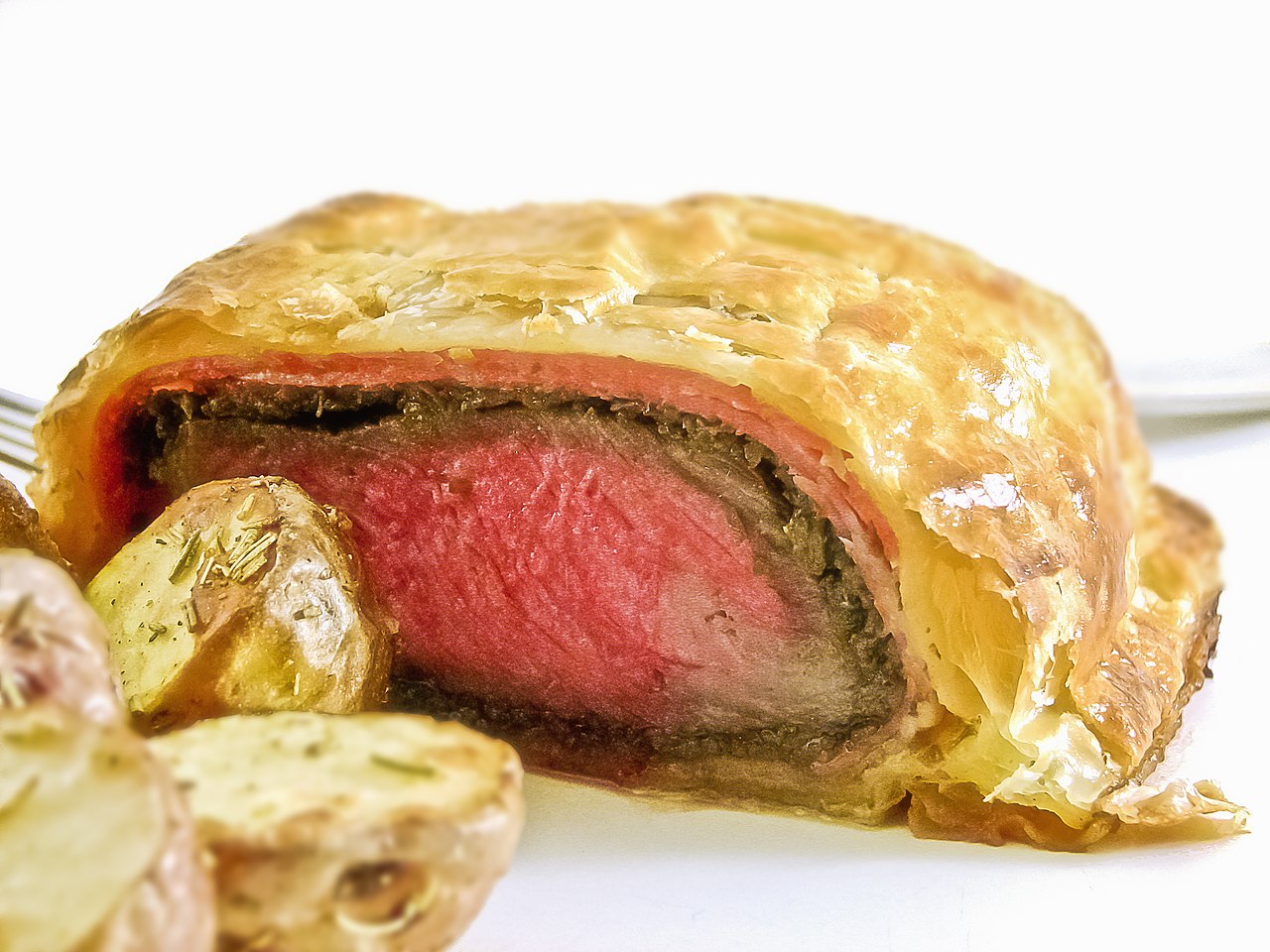
- United Kingdom. Fillet, with or without the chain; it is what goes into the beef Wellington in the photo [18].
- France. Filet, avec chaînette [4]; as portions, chateaubriand and tournedos [19], rated three stars for grilling [20].
- Brazil. Filé mignon (ABIEC B1111), with or without the cordão [21].
- Germany. Filet or Lende; the chain is the Kette [22]. In Austria, Lungenbraten [23].
- Italy. Filetto; the chain is the catenella [24].
- Japan. ヒレ (hire) in the retail standard [25].
- China. 里脊 (lǐji) or 牛柳 (niúliǔ) [26] [27]; in restaurants, 菲力 [28].
How to order it abroad
For the grill, ask for it whole and with the chain on; if you do not say so, it may come peeled.

| Where | What to say |
|---|---|
| US and UK | "A whole beef tenderloin with the chain (side strap) on." |
| France | « Un filet entier avec sa chaînette. » |
| Brazil | "Um filé mignon inteiro, com cordão." |
| Germany | „Ein ganzes Rinderfilet mit Kette (in Wien: ein ganzer Lungenbraten)." |
| Italy | «Un filetto intero con la catenella.» |
| China | 请给我一整条带侧条的里脊(牛柳)。 |
In Spain, ask for "un solomillo entero"; in Mexico and Chile, "un filete entero". More country-by-country tips in How to order Argentine cuts abroad.
Frequently asked questions
- What is lomo in English?
- Tenderloin; a bife de lomo is a filet mignon or tenderloin steak. In the US the piece with the chain on is IMPS 189A and the peeled one, without the chain, is 190A. In the UK it is called fillet.
- How long does beef tenderloin take on the grill?
- For medium-rare, La Nación gives 13 to 15 minutes per 500 g (about 1 lb) of tenderloin on the grill, over high heat and with just salt and pepper. The safe bet is to check doneness: overcooked, it loses its appeal.
- Is lomo the same as bife de chorizo?
- No. Lomo is the psoas major, which sits beneath the lumbar vertebrae, on the inside; bife de chorizo (strip loin) is the longissimus dorsi, which sits above them. The two appear together in the bife de costilla con lomo, or T-bone, one on each side of the bone.
- What is the chain on a tenderloin?
- It is the psoas minor muscle, the strip attached along the side of the tenderloin. Lomo 'sin cadena' (chain off) is sold without that muscle.
- What is lomo called in Spain or Mexico?
- In Spain it is solomillo, and in Mexico and Chile, filete. Careful: Spanish and Mexican 'lomo' are other cuts, from the steak area of the loin; in Mexico, 'lomo' is precisely the bife de chorizo.
- What is a lomito?
- The tenderloin sandwich, a classic from Córdoba. One of the best-known spots, open since 1971, builds it with 120 g (about 4 oz) of tenderloin.
Sources
- [1]IPCVA (Argentine Beef) — IPCVA — Nomenclador de cortes vacunos (argentinebeef.org.ar)argentinebeef.org.ar · accessed 8 November 2026
- [2]SENASA / Universidad Nacional de La Plata — Delprato, I. O. (1971). Componentes osteo-musculares de cortes que se practican en reses vacunas. SENASA / FCV-UNLPproduccion-animal.com.ar · accessed 8 November 2026
- [3]Instituto Nacional de Carnes — INAC (Uruguay) — Manual uruguayo de cortes bovinos (2023)uruguaymeats.uy · accessed 8 November 2026
- [4]UNECE — UNECE Standard Bovine Meat Carcases and Cuts, Edition 2004 (ECE/TRADE/326)digitallibrary.un.org · accessed 8 November 2026
- [5]La Nación — Lomo, el más tierno (con Néstor Contreras, de Cabernet), 12/02/2022lanacion.com.ar · accessed 8 November 2026
- [6]SENASA — Inocuidad alimentaria: el Senasa presente en los platos clásicos argentinosargentina.gob.ar · accessed 8 November 2026
- [7]SENASA — SENASA — Calidad diferenciada (cuota Hilton y otros cupos)argentina.gob.ar · accessed 8 November 2026
- [8]INTA EEA Bordenave — Fernández Mayer, A. (INTA EEA Bordenave). Calidad de la carne vacuna: factores que afectan la terneza, jugosidad y flavorvetcomunicaciones.com.ar · accessed 8 November 2026
- [9]Sitio Argentino de Producción Animal — Marchese, P. (2004). Los cortes de la carne vacuna y su preparación. Sitio Argentino de Producción Animalproduccion-animal.com.ar · accessed 8 November 2026
- [10]Crónica — El secreto del asado definitivo: en qué orden colocar carnes, chorizos, morcillas y achuras en la parrillacronica.com.ar · accessed 8 November 2026
- [11]USDA Agricultural Research Service — USDA ARS (2014). USDA Table of Cooking Yields for Meat and Poultry, Release 2ars.usda.gov · accessed 8 November 2026
- [12]Cocineros Argentinos (TV Pública) — Lomo a la pimienta con papas a la cremacocinerosargentinos.com · accessed 8 November 2026
- [13]Cocineros Argentinos (TV Pública) — Lomo al champiñón con papas españolascocinerosargentinos.com · accessed 8 November 2026
- [14]Infobae — Día Internacional del Sándwich: historias de cocineros ligados a tres clásicos de la gastronomía argentina (03/11/2023)infobae.com · accessed 8 November 2026
- [15]America's Test Kitchen (Cook's Country) — Slicing Against the Grain: What It Means and How to Do Itamericastestkitchen.com · accessed 8 November 2026
- [16]U.S. Meat Export Federation — International Nomenclature Guide of Beef Cuts (Huerta-Leidenz, 2013)usa-beef.org · accessed 8 November 2026
- [17]USDA Agricultural Marketing Service — Institutional Meat Purchase Specifications (IMPS), Fresh Beef, Series 100 (vigente desde noviembre de 2014)ams.usda.gov · accessed 8 November 2026
- [18]AHDB — Meat Purchasing Guide (beef, lamb, mutton, pork)projectblue.blob.core.windows.net · accessed 8 November 2026
- [19]Ministère de l'Agriculture / INTERBEV — Dénomination des morceaux – Guide de découpe de la viande bovine (version 2014)info.agriculture.gouv.fr · accessed 8 November 2026
- [20]INTERBEV (la-viande.fr) — Noms des morceaux, bœuf à grillerla-viande.fr · accessed 8 November 2026
- [21]ABIEC — Livro Brasileiro de Cortes Bovinos / Brazilian Beef Cuts Book (glosario en 12 idiomas)abiec.com.br · accessed 8 November 2026
- [22]Wikipedia (de) — Teilstücke des Rindfleischsde.wikipedia.org · accessed 8 November 2026
- [23]ichkoche.at — Gustostücke vom Rind (despiece vienés)ichkoche.at · accessed 8 November 2026
- [24]Confagricoltura Alessandria — I tagli della carne bovini (C. Barisone), con denominazioni regionaliconfagricolturalessandria.it · accessed 8 November 2026
- [25]全国食肉事業協同組合連合会 — 食肉小売品質基準 (norma de calidad para la venta minorista de carne, MAFF)ajmic.or.jp · accessed 8 November 2026
- [26]IPCVA (Argentine Beef) — 切割部位命名表 (nomenclador de cortes en chino)argentinebeef.org.ar · accessed 8 November 2026
- [27]AUS-MEAT — 澳洲肉品手册 第七版 (Handbook of Australian Meat, 7.ª ed., versión china; espejo no oficial)sstory.top · accessed 8 November 2026
- [28]SAC (norma nacional china) — GB/T 27643-2011 牛胴体及鲜肉分割chaxun.cqtzzlbzcxzx.cn · accessed 8 November 2026
Keep reading
- CutsBife de costilla: the Argentine T-bone and how to order it abroad
- CutsBife de chorizo in English: the Argentine strip steak explained
- CutsCuadril: the Argentine rump, its parts and what to call it abroad
- CutsColita de cuadril: the Argentine tri-tip, and why it is not picaña
- AsadoThe order of an Argentine asado: what goes on the grill first and why
- AsadoAsado cooking times by cut and grill height