

N.º 04Cuts
Osobuco: the Argentine beef shank cross cut, fore and hind
Osobuco is beef shank sliced across the bone with the marrow: brazuelo in front, garrón behind. How to braise it and how to order it in the US, UK and beyond.
Updated 8 min read33 sources

Contents
Osobuco is the leg of the steer cut into cross slices, with the bone and its marrow in the center. In English it is a beef shank cross cut, often sold as osso buco. It comes from two places: the brazuelo, the foreshank, and the garrón, the hindshank. These are locomotion muscles, high in collagen and tendon, that only become tender with long, moist cooking: in a covered pot, braised or in puchero (the Argentine boiled-meat stew). Abroad it is one of the easiest cuts to order, because the Italian name travels almost everywhere; the trap is Brazil, where garrão does not mean the same thing as in Argentina.
Osobuco
- Primal
- Garrón and brazuelo (hind and fore shank)
- Location
- The leg below the knee (garrón, hind shank) or the elbow (brazuelo, fore shank), cut into cross slices with the bone and its marrow.
- Also known as
- garrón (trasero) · brazuelo (delantero) · hueso con carne
- Quarter
- fore- and hindquarter
- Muscles
- Extensores y flexores digitales · Tibialis cranialis / Peroneus (garrón) · Biceps brachii / Brachialis (brazuelo)
- Bone
- Bone-in
- Cooking
- stew pot · braised · puchero (boiled dinner)
- IPCVA code
- 1013
- UNECE
- 1680
- HAM / AUS-MEAT
- 1680 · Shin/shank (bone-in)
Equivalents by country · Osobuco
- United StatesExact match
Beef shank, cross cut (osso buco); foreshank / hindshank
Code: IMPS 117/157
Slices with bone and marrow: 117 is the foreshank (brazuelo) and 157 the hindshank (garrón), without the heel (tortuguita).
- United KingdomExact match
Beef bucco / shin (fore shin, hind shin)
AHDB defines bucco as shin with the marrow bone, sliced.
- FranceExact match
Jarret (avant / arrière) en tranches
UNECE 1680 = jarret avant / jarret arrière. 'Osso buco' is the official sales name only for veal.
- BrazilExact match
Ossobuco / músculo do dianteiro / músculo traseiro
Code: ABIEC B2120/B1129
ABIEC: músculo do dianteiro = fore shank; músculo duro or garrão = hind shank. Trap: 'garrão' is not the tortuguita.
- GermanyExact match
Beinscheibe; Austria: Wadschinken (sin hueso)
Slice of Hesse with bone and marrow.
- ItalyExact match
Ossobuco / geretto (gamboncello en Nápoles)
The rear geretto is more tender; the front one goes more to stock.
- China
带骨腱子肉dàigǔ jiànziròu
IPCVA 1013/1680: 带骨前/后腱子肉; boneless it is 腱子肉 (GB/T, alias 牛展). The piece matches, but the cross-cut slices have no Chinese trade name.
How to ask for it
- English
Beef shank cross cuts (osso buco), 3 cm thick, with the marrow bone.
- French
Du jarret de bœuf coupé à la scie en tranches de 3 cm, avec l'os à moelle.
- German
Beinscheiben vom Rind, drei Zentimeter dick, mit Markknochen.
- Italian
Ossibuchi di manzo alti tre centimetri, col midollo.
- Portuguese
Ossobuco em rodelas de 3 cm, com o tutano.
- Chinese
请把带骨牛腱横切成3厘米厚的片,保留骨髓。
Where it comes from on the animal
- 1Cogote
- 2Aguja
- 3Chingolo
- 4Marucha
- 5Paleta
- 6Pecho
- Osobuco
- 8Bife ancho
- 9Tapa de asado
- 10Tira de asado
- 11Falda
- 12Bife de chorizo
- 13Vacío
- 14Tapa de cuadril
- 15Cuadril
- 16Colita
- 17Bola de lomo
- 18Nalga
- 19Cuadrada
- 20Peceto
- 21Tortuga
- Osobuco
- 23Lomo
- 24Entraña
- 25Matambre
Offal
- MollejasThymus: in the chest, next to the heart, and in the neck
- RiñónBelow the lumbar vertebrae, next to the lomo
- ChinchulinesSmall intestine, in the abdomen
The diagram highlights two areas: osobuco comes from both the foreleg and the hind leg.
The official cut list of the IPCVA (Argentine Beef Promotion Institute) records it as “garrón/brazuelo (osobuco)”, code 1013: “it is, without distinction, the tibia, humerus or radius, with their corresponding attached muscles”, sawn into pieces no larger than 200 mm (about 8 in) [1]. There are two origins:

- Front osobuco: the brazuelo (IPCVA 2311). The forearm, with portions of the humerus, radius, ulna and carpus. It carries the extensors and flexors of the carpus and digits, the biceps brachii (biceps brachii) and the brachialis (brachialis).
- Rear osobuco: the garrón (IPCVA 2475). The lower end of the femur, the tibia and the tarsus, with the long and lateral digital extensors, the peroneals, the tibialis anterior, the deep digital flexor and the popliteus.
The garrón is part of the rueda, the hind leg or round, along with the bola de lomo, nalga de adentro, cuadrada, peceto and tortuguita [2]. Note: the tortuguita, the calf muscle (heel muscle in English), is not part of the garrón: it is a separate cut.
In 1971 Ismael Delprato called these cross cuts “bone with meat”, and the shaft of the femur or humerus without meat “bone without meat”, or hueso caracú (marrow bone) [3].
Where the name comes from
“Osobuco” comes from the Italian ossobuco, which the Treccani dictionary traces to the Milanese os büs, “osso bucato”: bored bone. It is the name of a typical Milanese dish made with slices of veal leg with the bone and its marrow [23]. Pellegrino Artusi, in 1891, described it as “a muscular, bored piece of bone” from the leg (original: “un pezzo d'osso muscoloso e bucato”), and advised leaving the dish to the Milanese [24]. Agrofy translates it as “bone with a hole” [4]. Abroad, the Italian name is what circulates: in the United States the cut is sold as osso buco [5], and in France the official guide reserves osso buco as a retail name for veal [6].
In Horacio Vallejos's breakdown of the hindquarter, the garrón for osobuco appears around minute 9:23:
How to choose it
- Even slices. So they cook evenly, all the same thickness. In Milan they are cut 3 to 4 cm (1¼ to 1½ in) thick [25]; the Argentine cut list only requires that pieces not exceed 200 mm [1].
- With the marrow. It is part of the dish: Milanese ossobuco is defined by the bone with its marrow [23].
- Fresh. Firm, springy meat, deep red, with no liquid in the tray [33].
How to cook it and why
Pascualino Marchese writes that the hind garrón “is cut into thick slices to be used as ossobuco”, that “it is boiled to make stock”, and that boned out it yields “stewing meat used for stock and stews” [7].

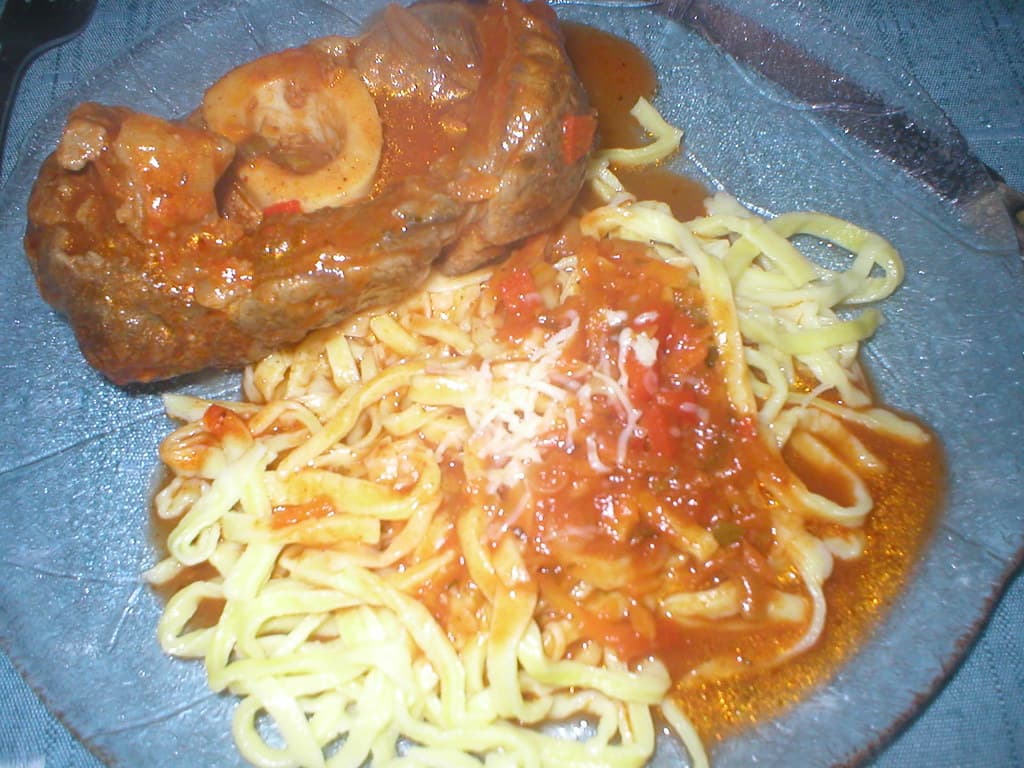
The reason is collagen. These are the muscles that move the leg, with a lot of connective tissue and tendon. Aníbal Fernández Mayer, of INTA Bordenave (INTA is the National Agricultural Technology Institute), sums it up: “the higher the collagen content, the tougher the muscle”, and the more collagen there is, the longer the cooking needed to turn it into gelatin [8]. That is why osobuco goes in the pot and not on the parrilla (the grill):
- Pot-braised or braised. In liquid, with time.
- Puchero and stock. The use Marchese gives the garrón.
Harold McGee gives the rule for these cuts: collagen only starts to dissolve between 70 and 80 °C (158–176 °F), so you have to cook slowly, just above that temperature, and take the meat out when the fibers pull apart with a fork [32]. The classic mistake is a hard, hurried boil.
In Italy, the hind geretto is considered more tender, and the front one goes more often to stock [9] [10].
Ossobuco alla milanese

The oldest written recipe dates from 1839: Francesco Cherubini recorded it in his Vocabolario milanese-italiano. In 2007 the dish received the municipal De.Co. designation, and the classic version uses 3 to 4 cm (1¼ to 1½ in) slices of milk-fed veal leg, finished with gremolada (gremolata), a very fine mince of lemon, garlic and parsley, and served with saffron risotto [25]. Step by step, according to the Milan website Milanofree [26]:
- Brown the slices, 3 or 4 minutes per side.
- Deglaze with white wine and let the alcohol cook off.
- Add hot stock, cover and cook over low heat for 1 hour 30 minutes to 2 hours with veal; with meat from an adult animal, 2 to 3 hours.
- Finish with the gremolada and serve with the risotto.
The version without tomato is the most traditional [26]. With osobuco from an adult animal, the long time is worth it.
Pot-braised osobuco and tuco
In Argentina, osobuco arrived with Italian immigrants and was for a long time an inexpensive dish [27]. Home versions dredge it in flour, brown it and cook it covered with red wine, stock and bay leaf, over low heat, for 2 to 3 hours, until the meat comes away from the bone [27]. On Cocineros Argentinos, Cami Pérez braises it in red wine with vegetables for about three hours over very low heat, and recommends skimming because the foam makes the sauce bitter [28]:
The same braise is the base of tuco con carne, the meat sauce for Sunday pasta: Paulina Cocina uses osobuco, carnaza (boneless stewing beef) or roast beef (the Argentine chuck cut), browned and cooked covered over low heat for at least an hour [29].
In the puchero
The River Plate puchero calls for bone-in cuts, “such as caracú or osobuco” [31]. In Infobae's recipe, falda (short plate) and osobuco boil for 15 minutes, then the vegetables go in and everything cooks 50 minutes more over low heat; the cabbage and sweet potato are cooked separately because they darken the broth [30].
What it's called in other countries
In the UN international standard it is the shin/shank, UNECE 1680, bone-in, which appears as “brazuelo/garrón” in the Spanish column [11]. Australia uses the same number and separates the front (1682) from the rear (1683).
- United States. Beef shank, cross cut, often sold as osso buco. The front one is the foreshank (IMPS 117) and the rear one the hindshank (IMPS 157), which is separated from the heel, the tortuguita [5] [12].
- United Kingdom. Beef bucco: AHDB defines it as shin with the marrow bone, sliced. Fore shin and hind shin are the front and the rear [13].
- France. Jarret (avant or arrière) sliced on the bone; the official guide sells it as jarret à mijoter. Osso buco is a retail name for veal only [6].
- Brazil. Ossobuco, as it appears in the Rio Grande do Sul tax standard [14]. ABIEC distinguishes the músculo do dianteiro (B2120) from the músculo duro or garrão (B1129), the rear one [15]. On supermarket shelves you see músculo dianteiro and músculo traseiro [16]. Trap: the Brazilian garrão is the osobuco, not the tortuguita.
- Germany. Beinscheibe, the slice of Hesse (shank) with bone and marrow [17] [18]. In Austria, Wadschinken is the boneless version, for goulash [19].
- Italy. Ossobuco or geretto; in Naples, gamboncello [9].
- China. Bone-in, the IPCVA names it 带骨前/后腱子肉 (dàigǔ qián/hòu jiànziròu); boneless it is 腱子肉 (jiànziròu), with the alias 牛展 (niúzhǎn) in the Chinese standard [20] [21] [22]. The piece matches, but the sliced cut has no Chinese trade name of its own: you have to describe it.
How to order it abroad
The key: with the bone and the marrow, in slices about 3 cm (1¼ in) thick.

| Where | What to say |
|---|---|
| US and UK | "Beef shank cross cuts (osso buco), 3 cm thick, with the marrow bone." |
| France | « Du jarret de bœuf coupé à la scie en tranches de 3 cm, avec l'os à moelle. » |
| Brazil | "Ossobuco em rodelas de 3 cm, com o tutano." |
| Germany | „Beinscheiben vom Rind, drei Zentimeter dick, mit Markknochen." |
| Italy | «Ossibuchi di manzo alti tre centimetri, col midollo.» |
| China | 请把带骨牛腱横切成3厘米厚的片,保留骨髓。 |
More country-by-country tips in How to order Argentine cuts abroad.
Frequently asked questions
- What is osobuco called in English?
- Beef shank cross cut, and in many markets also osso buco. The front one is foreshank (IMPS 117) and the rear one hindshank (IMPS 157). In the UK, beef bucco or shin.
- What is the difference between garrón and brazuelo?
- The garrón is the hind leg, over the tibia; the brazuelo is the foreleg, over the humerus, radius and ulna. Sliced across the bone, both are sold as osobuco.
- How long does it take to braise osobuco?
- Two to three hours, covered and over low heat, according to Argentine recipes; longer with steer osobuco than with veal. It is ready when the meat falls off the bone on its own.
- What does osobuco mean?
- It comes from the Milanese os büs, “bored bone”: the slice of leg with the hollow bone and its marrow in the center.
- What is gremolata on ossobuco alla milanese?
- It is a very fine mince of lemon zest, garlic and parsley added at the end over the braised ossobuco (gremolada in Milanese). It is part of the classic Milanese recipe.
- How long should you cook osobuco?
- A long time: these are locomotion muscles with collagen and tendon, which only get tender with long, moist cooking, in a pot, braised or in the puchero.
Sources
- [1]IPCVA (Argentine Beef) — IPCVA — Nomenclador de cortes vacunos (argentinebeef.org.ar)argentinebeef.org.ar · accessed 8 November 2026
- [2]IPCVA — IPCVA — Rueda (COD 1007)argentinebeef.org.ar · accessed 8 November 2026
- [3]SENASA / Universidad Nacional de La Plata — Delprato, I. O. (1971). Componentes osteo-musculares de cortes que se practican en reses vacunas. SENASA / FCV-UNLPproduccion-animal.com.ar · accessed 8 November 2026
- [4]Agrofy News — Arroyo, L. (2017). Los nombres de los cortes de carne y su particular origennews.agrofy.com.ar · accessed 8 November 2026
- [5]USDA Agricultural Marketing Service — Institutional Meat Purchase Specifications (IMPS), Fresh Beef, Series 100 (vigente desde noviembre de 2014)ams.usda.gov · accessed 8 November 2026
- [6]Ministère de l'Agriculture / INTERBEV — Dénomination des morceaux – Guide de découpe de la viande bovine (version 2014)info.agriculture.gouv.fr · accessed 8 November 2026
- [7]Sitio Argentino de Producción Animal — Marchese, P. (2004). Los cortes de la carne vacuna y su preparación. Sitio Argentino de Producción Animalproduccion-animal.com.ar · accessed 8 November 2026
- [8]INTA EEA Bordenave — Fernández Mayer, A. (INTA EEA Bordenave). Calidad de la carne vacuna: factores que afectan la terneza, jugosidad y flavorvetcomunicaciones.com.ar · accessed 8 November 2026
- [9]Confagricoltura Alessandria — I tagli della carne bovini (C. Barisone), con denominazioni regionaliconfagricolturalessandria.it · accessed 8 November 2026
- [10]RCS Libri / Hub Scuola — La scuola di cucina: i tagli del bovino adulto e loro utilizzo (Gentili, 2008)ms-mms.hubscuola.it · accessed 8 November 2026
- [11]UNECE — UNECE Standard Bovine Meat Carcases and Cuts, Edition 2004 (ECE/TRADE/326)digitallibrary.un.org · accessed 8 November 2026
- [12]Defense Commissary Agency (DeCA) — Technical Data Sheet for Fresh/Frozen Beef Products (2012)pprd.commissaries.com · accessed 8 November 2026
- [13]AHDB — Meat Purchasing Guide (beef, lamb, mutton, pork)projectblue.blob.core.windows.net · accessed 8 November 2026
- [14]Governo do Rio Grande do Sul — Instrução Normativa DRP nº 63/2002 (lista fiscal de cortes)normasbrasil.com.br · accessed 8 November 2026
- [15]ABIEC — Livro Brasileiro de Cortes Bovinos / Brazilian Beef Cuts Book (glosario en 12 idiomas)abiec.com.br · accessed 8 November 2026
- [16]Tramontina — Mini Bíblia do Churrascotramontina.com.br · accessed 8 November 2026
- [17]U.S. Meat Export Federation — International Nomenclature Guide of Beef Cuts (Huerta-Leidenz, 2013)usa-beef.org · accessed 8 November 2026
- [18]Lebensmittel Praxis — Warenverkaufskunde: Teilstücke vom Rind (J. Hertling, 2023)lebensmittelpraxis.de · accessed 8 November 2026
- [19]ichkoche.at — Gustostücke vom Rind (despiece vienés)ichkoche.at · accessed 8 November 2026
- [20]IPCVA (Argentine Beef) — 切割部位命名表 (nomenclador de cortes en chino)argentinebeef.org.ar · accessed 8 November 2026
- [21]SAC (norma nacional china) — GB/T 27643-2011 牛胴体及鲜肉分割chaxun.cqtzzlbzcxzx.cn · accessed 8 November 2026
- [22]AUS-MEAT — 澳洲肉品手册 第七版 (Handbook of Australian Meat, 7.ª ed., versión china; espejo no oficial)sstory.top · accessed 8 November 2026
- [23]Treccani — Ossobuco, Vocabolariotreccani.it · accessed 8 November 2026
- [24]Project Gutenberg — Artusi, P. (1891). La scienza in cucina e l'arte di mangiar bene (recetas 358 y 363)gutenberg.org · accessed 8 November 2026
- [25]Wikipedia (it) — Ossobuco alla milaneseit.wikipedia.org · accessed 8 November 2026
- [26]Milanofree — Ossobuco alla milanese: ricetta originale e gremoladamilanofree.it · accessed 8 November 2026
- [27]La Voz de San Justo — El renacimiento del osobucolavozdesanjusto.com.ar · accessed 8 November 2026
- [28]Cocineros Argentinos (TV Pública) — Ossobuco braseado al vino tintococinerosargentinos.com · accessed 8 November 2026
- [29]Paulina Cocina — 7 trucos para tus fideos con tuco perfectospaulinacocina.net · accessed 8 November 2026
- [30]Infobae — Todos los tips para hacer un verdadero puchero de carneinfobae.com · accessed 8 November 2026
- [31]Wikipedia (es) — Pucheroes.wikipedia.org · accessed 8 November 2026
- [32]Scribner (vía ckbk) — McGee, H. (2004). On Food and Cooking, «Tough and Large Cuts: Slower Means Moister»app.ckbk.com · accessed 8 November 2026
- [33]SENASA — Pautas para la prevención de enfermedades a través de la elección de alimentosargentina.gob.ar · accessed 8 November 2026
Keep reading
- CutsTortuguita: the beef heel muscle, how to cook it and what to ask for
- CutsCogote: Argentine beef neck, how to cook it and what to ask for
- CutsPecho: Argentina's brisket cut, how to cook it and what to ask for
- CutsFalda: the Argentine short plate cut, where it comes from and its names
- CutsPaleta: the Argentine shoulder clod and the centro de paleta
- CutsPeceto: the Argentine eye of round, the vitel toné cut